
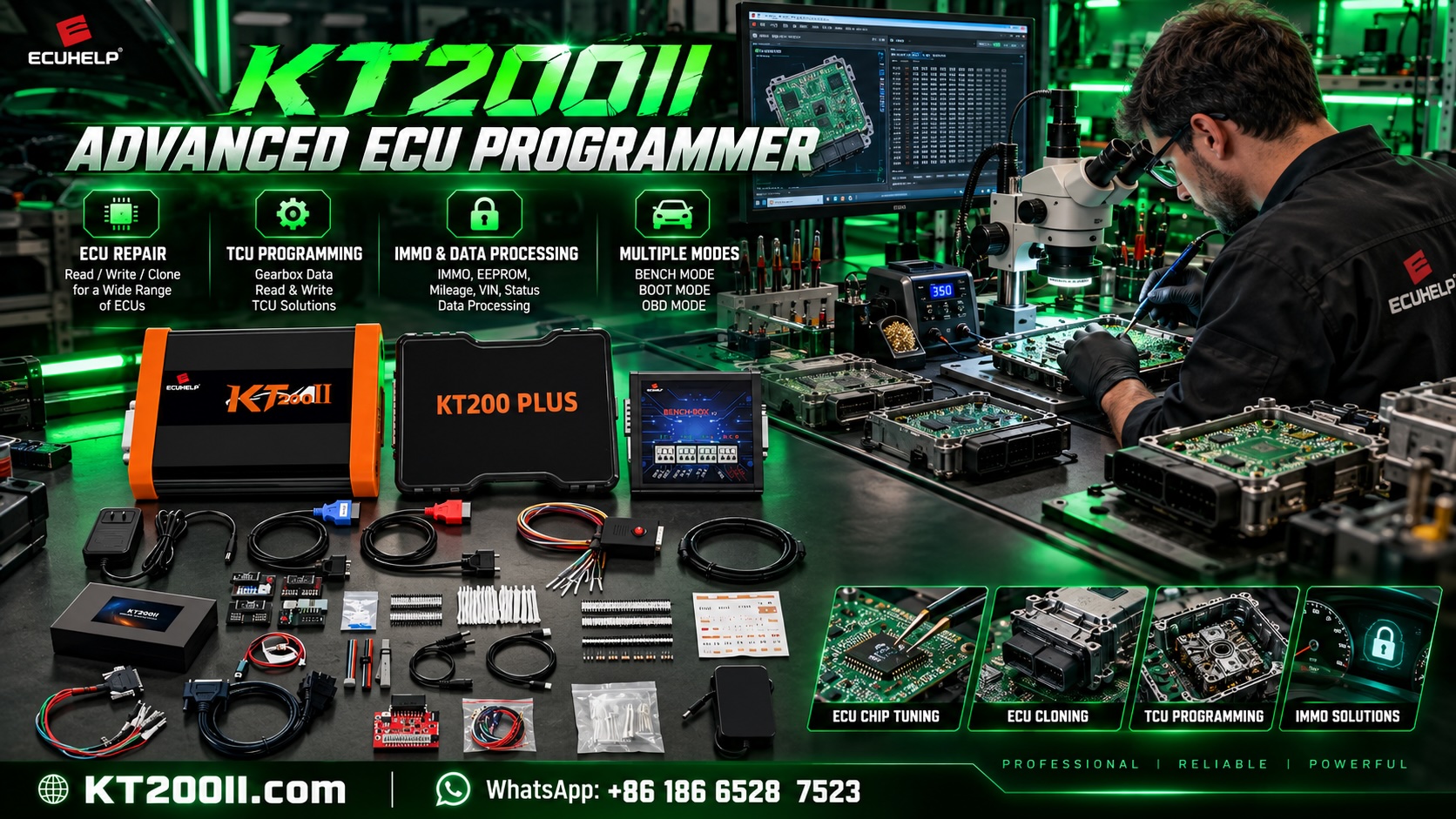
Automotive ECU and TCU Repair: Common Electronic Control Module Problems and Solutions
Modern vehicles depend on electronic control modules to manage engine performance, transmission operation and numerous vehicle functions. The Engine Control Unit (ECU) and Transmission Control Unit (TCU) are two of the most important modules in automotive electronic systems.
When these modules develop faults, vehicles may experience starting difficulties, transmission shifting problems, communication failures or unexpected warning lights. Professional ECU and TCU repair requires a combination of electronic diagnostics, programming knowledge and practical troubleshooting skills.
This guide explains common control module problems, diagnostic procedures, repair methods and important considerations for automotive electronics technicians.
1. Understanding ECU and TCU Functions
Before diagnosing electronic control module problems, it is important to understand the role of each module.
Engine Control Unit (ECU)
The ECU manages engine operation by processing sensor information and controlling different engine systems.
Its functions may include:
- Fuel injection quantity and timing.
- Ignition timing control.
- Turbocharger boost management.
- Engine torque management.
- Air-fuel ratio regulation.
- Emissions control.
- Engine protection strategies.
Transmission Control Unit (TCU)
The TCU manages electronic transmission operation and communicates with other vehicle control modules.
Depending on the transmission architecture, its functions may include:
- Gear selection and shifting strategies.
- Clutch engagement control.
- Hydraulic pressure management.
- Transmission adaptation.
- Temperature monitoring.
- Transmission protection functions.
2. Common Symptoms of ECU and TCU Failure
Electronic control module problems can produce different symptoms depending on the affected hardware, software or communication circuit.
Engine Starting Problems
A faulty ECU, damaged power supply circuit or communication problem may prevent the engine management system from operating correctly.
Unstable Engine Performance
Incorrect sensor signals, damaged ECU driver circuits or software problems may cause rough idling, hesitation and reduced engine performance.
Transmission Shifting Problems
A faulty TCU or related electrical problem may cause delayed shifting, harsh gear changes, incorrect gear selection or transmission failsafe operation.
Communication Failure
If diagnostic equipment cannot communicate with an ECU or TCU, possible causes include damaged wiring, power supply problems, CAN bus faults or internal module damage.
Repeated Diagnostic Trouble Codes
Persistent fault codes may indicate an unresolved electrical, mechanical, software or communication problem. A fault code should be investigated rather than automatically treated as proof of ECU failure.
3. Checking Power Supply and Ground Connections
Power supply and ground problems are common causes of electronic control module malfunctions.
Before opening an ECU or TCU, technicians should inspect:
- Battery condition and voltage stability.
- Module permanent power supply.
- Ignition-switched power supply.
- Ground connections.
- Fuses and relays.
- Connector terminals and wiring condition.
A poor ground connection or damaged power supply circuit can create symptoms similar to internal electronic module failure.
Use suitable electrical testing equipment and follow the manufacturer's voltage and wiring specifications.
4. CAN Bus Communication Troubleshooting
Modern vehicles use communication networks to exchange information between electronic control modules.
CAN bus is widely used to connect the ECU, TCU, ABS, instrument cluster and other vehicle systems.
Common communication problems include:
- Damaged CAN-H or CAN-L wiring.
- Short circuits in communication lines.
- Corroded connectors.
- Incorrect network termination.
- Faulty communication transceivers.
- Internal module failures.
Technicians should consult the correct wiring diagram and use appropriate diagnostic equipment to evaluate communication signals.
Network resistance and voltage measurements must be interpreted according to the specific vehicle architecture.
5. Internal ECU and TCU Hardware Problems
If external wiring, power supply and communication circuits are functioning correctly, internal control module hardware may require investigation.
Common electronic component failures include:
- Damaged voltage regulators.
- Defective capacitors.
- Failed MOSFETs and driver components.
- Damaged CAN communication transceivers.
- Corrosion caused by moisture intrusion.
- Overheating-related component damage.
- Cracked solder joints.
Component-level repair requires suitable electronic testing equipment, technical documentation and experience working with automotive circuit boards.
Before replacing internal components, technicians should identify the actual failure and investigate the conditions that caused it.
6. ECU and TCU Software Problems
Not all electronic control module failures are caused by damaged hardware. Software and memory problems can also prevent modules from operating correctly.
Common software-related problems include:
- Interrupted programming operations.
- Incorrect software files.
- Incomplete Flash writing.
- Memory data corruption.
- Checksum errors.
- Incompatible software versions.
When software problems are suspected, technicians should identify the exact hardware and software numbers before attempting recovery.
Original data backups should be preserved whenever possible.
7. Understanding Flash and EEPROM Memory
Flash and EEPROM are important memory technologies used in automotive electronic control modules.
Flash Memory
Flash memory commonly stores application software and calibration data.
Depending on the ECU or TCU, it may contain:
- Control module application software.
- Engine or transmission calibration data.
- Control algorithms.
- Diagnostic functions.
EEPROM Memory
EEPROM may store configuration information, adaptation values and other vehicle-specific data.
Depending on the module architecture, this information may be important during module replacement and supported cloning operations.
Some modern modules use integrated non-volatile memory instead of a separate EEPROM chip.
8. ECU and TCU Reading and Writing Methods
Professional automotive programming equipment may provide several methods for accessing control modules.
OBD Programming
OBD programming communicates with supported modules through the vehicle diagnostic connector.
It is convenient for many in-vehicle reading and writing operations.
Bench Programming
Bench programming connects directly to the control module through its external connector after removal from the vehicle.
It is useful when direct module access is required or when certain operations are unavailable through OBD.
Boot Programming
Boot programming provides specialized access to supported microcontroller architectures through designated hardware connections or boot procedures.
Depending on the module, it may support memory operations unavailable through standard diagnostic communication.
Not every ECU or TCU supports all programming methods. Always verify the exact protocol and connection requirements.
9. ECU and TCU Cloning During Module Replacement
When an original electronic control module is damaged beyond economical repair, a compatible replacement may be required.
ECU or TCU cloning involves transferring supported original data to a compatible replacement module.
A typical workflow includes:
- Identify the original module and record its hardware number.
- Check the replacement module's hardware compatibility.
- Read the original supported memory areas.
- Save and verify the original data backup.
- Confirm software and memory compatibility.
- Transfer the supported data to the replacement module.
- Perform required coding, adaptation or synchronization.
- Complete diagnostic and functional testing.
Cloning requirements differ between ECU and TCU architectures. Some modules require additional configuration or manufacturer-specific procedures.
10. A Professional ECU and TCU Repair Workflow
A systematic diagnostic process helps technicians avoid unnecessary module replacement and improve repair accuracy.
- Identify the vehicle: Record vehicle information and control module identification.
- Read diagnostic codes: Check the ECU, TCU and related vehicle systems.
- Inspect electrical connections: Verify power, ground, fuses and wiring.
- Check communication: Investigate CAN bus and diagnostic communication.
- Analyze live data: Compare sensor values and operating parameters.
- Inspect module hardware: Investigate internal electronic faults when necessary.
- Verify software: Check memory integrity and software compatibility.
- Perform supported repairs: Restore, program or replace the module as required.
- Verify the result: Perform final diagnostics and functional tests.
11. Choosing Professional ECU and TCU Programming Equipment
Reliable programming equipment is important for automotive electronics workshops that handle different vehicle manufacturers and control module families.
When evaluating programming equipment, consider:
- ECU and TCU manufacturer coverage.
- Supported hardware and software versions.
- OBD, Bench and Boot programming modes.
- Flash and EEPROM reading capabilities.
- Supported writing and recovery operations.
- ECU and TCU cloning functions.
- Wiring diagrams and technical documentation.
- Software updates and technical support.
General module coverage does not automatically guarantee support for every reading, writing or cloning operation. Always check the exact protocol and supported functions.
For more information about automotive programming technology and electronic control module solutions, visit KT-Prog.
12. Preventing Future Electronic Control Module Problems
Although some ECU and TCU failures are unavoidable, proper electrical maintenance and programming practices can reduce unnecessary risks.
- Maintain a healthy vehicle battery.
- Inspect charging system performance.
- Repair damaged wiring and connectors.
- Prevent moisture from entering electronic modules.
- Use a suitable regulated power supply during programming.
- Keep original data backups.
- Verify software compatibility before writing.
- Follow manufacturer repair and programming procedures.
13. Conclusion
ECU and TCU repair is an important part of modern automotive electronics services. Problems can originate from power supply circuits, communication networks, internal electronic components or corrupted software.
Successful repair requires a systematic diagnostic approach, accurate module identification and suitable programming equipment.
By understanding electronic control module architecture, memory technologies and OBD, Bench and Boot programming methods, technicians can improve repair efficiency and handle a wider range of automotive electronic problems.
Visit KT-Prog for more information about automotive ECU and TCU programming technology.