
ECU Recovery After Failed Programming: Causes, Diagnosis and Solutions
Electronic Control Units (ECUs) are responsible for managing important vehicle functions, including fuel injection, ignition timing, turbocharger control and engine protection. Modern ECUs rely on complex software and memory structures to perform these operations.
During ECU programming, unexpected problems such as power interruptions, communication failures or incompatible software files can interrupt the process. In some situations, the ECU may stop communicating with diagnostic equipment or fail to operate correctly.
ECU recovery is an important part of professional automotive electronics repair. Understanding why programming failures happen and how different recovery methods work helps technicians handle damaged or unresponsive control modules more effectively.
1. What Is ECU Recovery?
ECU recovery refers to procedures used to restore the operation of an electronic control unit after certain software or programming failures.
Depending on the ECU architecture and the type of failure, recovery may involve:
- Restoring original software.
- Rewriting supported Flash memory areas.
- Using an alternative programming access method.
- Recovering communication with the control module.
- Correcting compatible software or memory errors.
- Replacing damaged electronic components when necessary.
Not every ECU failure can be resolved through software recovery. If the microcontroller, power supply circuit or other internal hardware is damaged, additional electronic repair may be required.
2. Common Causes of Failed ECU Programming
Understanding the cause of a programming failure is the first step toward selecting an appropriate recovery procedure.
Power Supply Interruption
Unstable voltage or an unexpected loss of power during programming can interrupt memory operations.
Depending on the ECU architecture and the stage of programming, this may result in incomplete software data or loss of normal communication.
Communication Failure
Loose connections, damaged cables, incorrect wiring or communication network problems can interrupt communication between the ECU and programming equipment.
Incorrect Software File
Writing a file that does not match the target ECU hardware or software version can cause programming errors or prevent the module from operating correctly.
Incorrect Programming Protocol
Selecting an incompatible ECU protocol or programming method may cause the reading or writing operation to fail.
Checksum Problems
Some ECUs require checksum validation or correction during software modification. Incorrect checksum handling can cause software integrity problems.
Hardware Failure
Internal ECU components may already be damaged before programming begins. Voltage regulators, communication transceivers, memory devices and processor circuits can all affect programming reliability.
3. Symptoms of an ECU That Needs Recovery
An ECU affected by a programming failure may show several different symptoms.
- The diagnostic tool cannot communicate with the ECU.
- The ECU identification information is unavailable.
- The engine does not start after programming.
- The programming operation repeatedly fails.
- The ECU appears to power on but does not respond correctly.
- Communication is available only through certain programming methods.
- Unexpected diagnostic trouble codes appear after software writing.
These symptoms do not automatically confirm corrupted ECU software. Technicians should first exclude external power, ground, wiring and communication problems.
4. Initial Checks Before ECU Recovery
Before attempting recovery, technicians should perform basic electrical and compatibility checks.
Check the Power Supply
Verify that the ECU receives the correct operating voltage and that the power supply remains stable.
Inspect Ground Connections
Check ground terminals, connector condition and electrical continuity according to the ECU wiring diagram.
Verify Communication Wiring
Inspect CAN-H, CAN-L, K-Line or other communication connections required by the target ECU.
Confirm ECU Identification
Record the manufacturer, hardware number, software identification and microcontroller information where available.
Review Programming History
Determine which programming operation failed, which memory area was being written and whether an original backup is available.
These checks help technicians distinguish software corruption from external electrical or hardware problems.
5. ECU Recovery Through OBD, Bench and Boot Modes
Different programming methods provide different levels of access to automotive control modules.
OBD Recovery
Some ECUs remain accessible through the vehicle diagnostic connector after certain programming failures.
If the module still supports the required communication and recovery procedure, compatible original software may be restored through OBD.
Bench Recovery
Bench programming connects directly to the ECU through its external connector after module removal.
This method may provide an alternative communication path when in-vehicle access is unavailable.
Boot Recovery
Boot mode uses specialized access procedures for supported microcontroller architectures.
Depending on the ECU, Boot mode may provide access to certain memory operations when normal diagnostic communication is unavailable.
However, not every ECU supports Boot recovery, and some failures cannot be resolved without hardware repair.
6. Understanding Flash Memory During ECU Recovery
Flash memory commonly stores ECU application software and calibration data.
When a Flash writing operation is interrupted, the affected memory region may contain incomplete or invalid data.
Depending on the ECU architecture, recovery may require:
- Identifying the affected Flash memory region.
- Confirming the correct hardware and software version.
- Obtaining a compatible original software file.
- Using a supported programming access method.
- Verifying software integrity after writing.
Some ECUs use protected memory regions or specialized bootloader mechanisms. Their recovery requirements depend on the specific microcontroller and software architecture.
7. The Importance of Original ECU Backups
Original ECU backups are extremely valuable during recovery operations.
Before performing programming or calibration work, technicians should save all supported original memory data.
A verified backup can help with:
- Restoring original ECU software.
- Comparing original and modified files.
- Investigating programming failures.
- Supporting compatible ECU replacement procedures.
- Preserving vehicle-specific configuration information.
Backups should be clearly labeled with ECU hardware numbers, software identification and memory type.
A partial Flash backup should not be treated as a complete backup if other required memory areas were not read.
8. ECU Software Recovery vs. Hardware Repair
It is important to distinguish software-related ECU problems from internal electronic hardware failures.
| Problem Type | Possible Solution |
|---|---|
| Incomplete Flash writing | Supported software restoration |
| Incorrect software file | Compatible original file restoration |
| Communication wiring fault | Electrical diagnosis and wiring repair |
| Damaged power supply circuit | Component-level electronic repair |
| Defective communication transceiver | Hardware diagnosis and replacement |
| Damaged microcontroller | Specialized repair or ECU replacement |
Repeated programming attempts without identifying the underlying problem can make recovery more difficult. A proper diagnosis should always come before further writing operations.
9. Common Mistakes During ECU Recovery
Several mistakes can increase the risk of additional ECU damage.
- Repeatedly attempting programming without checking the power supply.
- Using software files from incompatible ECU versions.
- Selecting the wrong programming protocol.
- Ignoring wiring and communication problems.
- Assuming every ECU can be recovered through Boot mode.
- Writing incomplete or unverified backup files.
- Disconnecting power during recovery operations.
- Ignoring possible internal hardware damage.
Professional recovery procedures should be based on accurate ECU identification, verified software data and the manufacturer's supported programming methods.
10. Choosing an ECU Programming Tool with Recovery Support
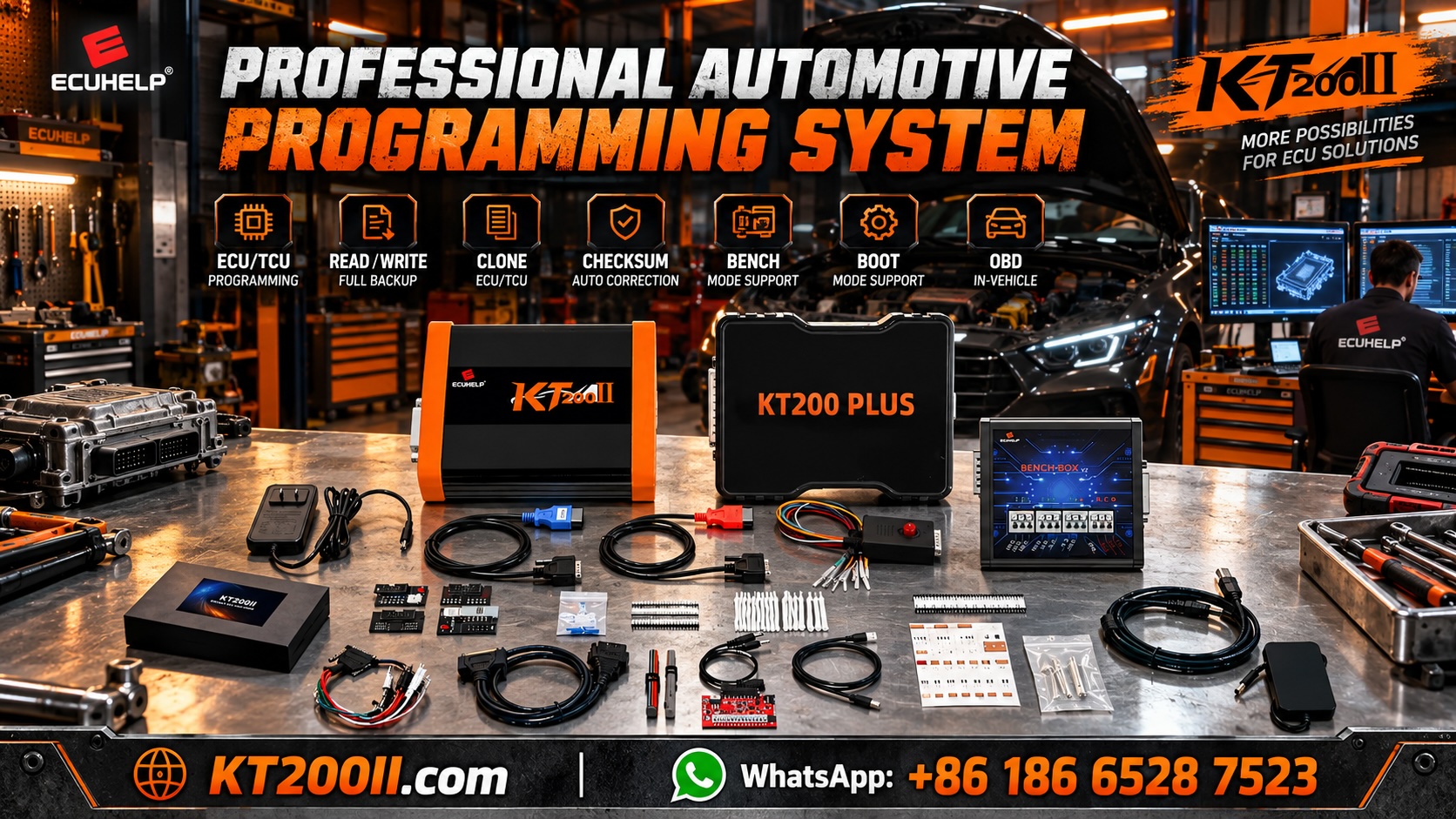
For automotive electronics workshops, programming equipment with appropriate recovery capabilities can be an important investment.
When evaluating an ECU programming tool, consider:
- OBD, Bench and Boot programming support.
- ECU manufacturer and model coverage.
- Supported microcontroller architectures.
- Flash and EEPROM reading capabilities.
- Supported software writing and recovery operations.
- Original data backup functions.
- Connection diagrams and technical documentation.
- Software updates and technical support.
Always verify the exact ECU protocol and supported recovery functions. General ECU family compatibility does not guarantee that every damaged module can be recovered.
Visit KT-Prog to explore automotive ECU programming equipment and electronic control module solutions.
11. Best Practices to Prevent ECU Programming Failures
Preventing programming problems is generally easier than recovering a damaged ECU.
- Identify the exact ECU hardware and software version.
- Verify programming protocol compatibility before starting.
- Use a suitable regulated power supply.
- Check all connections and wiring diagrams.
- Read and save original supported memory data.
- Verify file integrity before writing.
- Avoid unnecessary interruptions during programming.
- Follow the programming equipment manufacturer's instructions.
- Perform communication and diagnostic checks after writing.
12. Conclusion
ECU recovery is an important part of professional automotive electronics repair. Failed programming operations, interrupted Flash writing, communication problems and incompatible software can all affect control module operation.
Successful recovery requires accurate ECU identification, proper electrical testing, verified original data and a programming method compatible with the target module.
Understanding the differences between OBD, Bench and Boot access also helps technicians choose a suitable recovery approach instead of repeating unsuccessful programming attempts.
With appropriate programming equipment and systematic troubleshooting, automotive professionals can improve their ability to diagnose and recover supported electronic control modules.
For more information about automotive ECU programming technology and professional programming equipment, visit KT-Prog.