
Gasoline ECU Programming: Understanding MED17, MG1 and Modern Engine Management
Modern gasoline engines rely on advanced electronic control systems to manage fuel injection, ignition timing, air intake, turbocharger operation and engine protection. At the center of these systems is the Engine Control Unit (ECU), which continuously processes sensor information and adjusts engine operation according to different driving conditions.
Gasoline ECU programming is an important part of modern automotive electronics repair and performance calibration. Understanding ECU architectures such as Bosch MED17 and MG1 helps technicians identify control modules, select compatible programming methods and perform supported software operations.
1. What Is a Gasoline Engine Control Unit?
A gasoline ECU is an electronic controller responsible for managing the operation of a gasoline engine.
It receives information from different sensors and controls electronic actuators to maintain engine performance, efficiency and emissions compliance.
Depending on the engine architecture, ECU functions may include:
- Fuel injection quantity and timing.
- Ignition timing control.
- Air-fuel ratio regulation.
- Electronic throttle control.
- Turbocharger boost management.
- Knock detection and correction.
- Engine torque management.
- Engine temperature protection.
- Diagnostic monitoring.
2. Understanding Gasoline Direct Injection
Gasoline Direct Injection (GDI) is widely used in modern gasoline engines.
Unlike traditional port fuel injection, which delivers fuel into the intake ports, GDI systems inject fuel directly into the combustion chamber.
The main components generally include:
- High-pressure fuel pump.
- Fuel rail.
- Direct injection injectors.
- Fuel pressure sensor.
- Engine control unit.
- Low-pressure fuel supply system.
The ECU coordinates injection timing, fuel quantity and pressure according to engine speed, load, temperature and other operating conditions.
Accurate fuel management is essential for combustion efficiency, engine performance and emissions control.
3. Bosch MED17 ECU Architecture
Bosch MED17 is an important gasoline engine management platform used in various turbocharged and naturally aspirated gasoline engines.
Depending on the specific version, MED17 systems may manage:
- Direct fuel injection.
- Ignition timing.
- Electronic throttle control.
- Turbocharger boost pressure.
- Fuel pressure regulation.
- Knock control.
- Engine torque management.
- Emissions-related functions.
Different MED17 variants use different hardware configurations, microcontrollers and memory structures.
For programming purposes, identifying the exact ECU part number and software version is more important than relying only on the MED17 family name.
4. Bosch MG1: A Modern Gasoline ECU Platform
MG1 is a newer generation of gasoline engine control architecture used in various modern vehicles.
Compared with older ECU generations, MG1 platforms may feature more advanced processing capabilities, memory architectures and electronic protection mechanisms.
Depending on the specific application, MG1 controllers may manage:
- Advanced gasoline direct injection.
- Multiple injection strategies.
- Ignition and knock control.
- Turbocharger management.
- Electronic torque coordination.
- Engine protection strategies.
- Emissions monitoring.
Different MG1 variants may use different microcontrollers, hardware configurations and programming protocols.
Technicians should always confirm the exact MG1 model and supported programming functions before beginning an operation.
5. Understanding Ignition Timing Control
Ignition timing determines when the spark plug fires in relation to the position of the piston and crankshaft.
Correct ignition timing is essential for efficient combustion and reliable engine operation.
Gasoline ECU calibration may consider:
- Engine speed.
- Engine load.
- Intake air temperature.
- Coolant temperature.
- Fuel octane rating.
- Knock sensor information.
- Combustion protection limits.
The ECU may adjust ignition timing dynamically when knock or abnormal operating conditions are detected.
Incorrect ignition calibration can increase knock risk and engine temperature. Professional calibration must consider the manufacturer's mechanical and thermal limits.
6. Fuel Injection and Lambda Control
Fuel injection and lambda control are essential parts of gasoline engine management.
The ECU calculates fuel delivery based on available air, engine load and operating conditions.
Important parameters may include:
- Injection quantity.
- Injection duration.
- Injection timing.
- Target air-fuel ratio.
- Fuel pressure.
- Lambda sensor feedback.
- Fuel temperature compensation.
Lambda sensors provide feedback about combustion conditions, allowing the ECU to adjust fuel delivery and maintain the required operating mixture.
7. Turbocharger and Boost Pressure Management
Many modern gasoline engines use turbochargers to increase the amount of air entering the engine.
The ECU controls turbocharger operation through different strategies depending on engine load, speed and temperature.
Common boost-related parameters include:
- Target boost pressure.
- Boost pressure limitation.
- Wastegate control.
- Turbocharger actuator positioning.
- Intake pressure monitoring.
- Temperature-based protection.
Boost pressure must be coordinated with fuel injection, ignition timing and engine torque management.
Increasing boost without considering fuel quality, knock control and mechanical limitations can cause serious engine damage.
8. Understanding Gasoline ECU Flash and EEPROM Memory
Modern gasoline ECUs use different memory technologies to store software and vehicle-specific information.
Flash Memory
Flash memory commonly stores the main ECU application software and calibration data.
Depending on the ECU, this information may include:
- Engine management software.
- Fuel injection calibration.
- Ignition timing maps.
- Boost control parameters.
- Torque management strategies.
- Engine protection functions.
EEPROM and Data Flash
Non-volatile memory may store configuration information, adaptation values and other application-specific data.
Some modern ECU architectures integrate non-volatile storage into the main microcontroller rather than using a separate EEPROM chip.
Microcontroller Architecture
Modern gasoline ECUs may use advanced automotive microcontrollers with integrated memory and security mechanisms.
Different processor generations may require different programming protocols and memory access procedures.
9. OBD, Bench and Boot Programming Methods
Professional gasoline ECU programming equipment may provide different access methods depending on the exact control module.
OBD Programming
OBD programming communicates with supported ECUs through the vehicle diagnostic connector.
It is convenient for supported ECU identification, reading and writing operations without removing the control module.
Bench Programming
Bench programming connects directly to the ECU through its external connector after removal from the vehicle.
This method is useful when direct module access is required or when the necessary programming operation is unavailable through OBD.
Boot Programming
Boot programming uses specialized access procedures for supported microcontroller architectures.
Depending on the ECU design, Boot mode may provide access to specific memory operations unavailable through standard diagnostic communication.
Not every MED17 or MG1 ECU supports all three programming methods. Always verify the exact hardware number and programming protocol.
10. Gasoline ECU Reading, Writing and Cloning
Professional ECU programming equipment may support different memory operations depending on the target controller.
These operations may include:
- Reading supported original ECU software.
- Backing up Flash memory.
- Reading supported EEPROM or Data Flash.
- Writing compatible software files.
- Restoring original data.
- Performing supported ECU cloning procedures.
When replacing a damaged gasoline ECU, technicians should verify hardware compatibility and determine whether additional configuration, immobilizer adaptation or manufacturer-specific synchronization is required.
A simple memory transfer does not guarantee that every replacement ECU will operate correctly.
11. Common Gasoline ECU Problems
Ignition System Faults
Ignition-related problems may be caused by spark plugs, ignition coils, wiring, sensor signals or ECU driver circuits.
Fuel Pressure Problems
Incorrect fuel pressure readings may result from sensor faults, high-pressure pump problems, fuel delivery issues or wiring damage.
Knock Sensor Problems
Incorrect knock sensor signals can affect ignition timing and engine protection strategies.
Boost Pressure Faults
Turbocharger actuator faults, intake leaks, sensor problems or control circuit failures may result in abnormal boost pressure.
ECU Communication Failure
Communication problems may involve power supply, ground connections, CAN wiring, programming compatibility or internal electronic component damage.
12. Choosing a Gasoline ECU Programming Tool
Professional workshops need programming equipment that supports their target gasoline ECU architectures and required operations.
Important selection criteria include:
- Bosch MED17 and MG1 protocol coverage.
- Support for different gasoline ECU manufacturers.
- Accurate hardware and software identification.
- OBD, Bench and Boot programming capabilities.
- Flash and EEPROM reading functions.
- Supported writing and recovery operations.
- Original data backup capabilities.
- Connection diagrams and technical documentation.
- Software updates and technical support.
General ECU family coverage does not automatically guarantee support for every hardware revision or memory operation. Always verify the exact ECU protocol before programming.
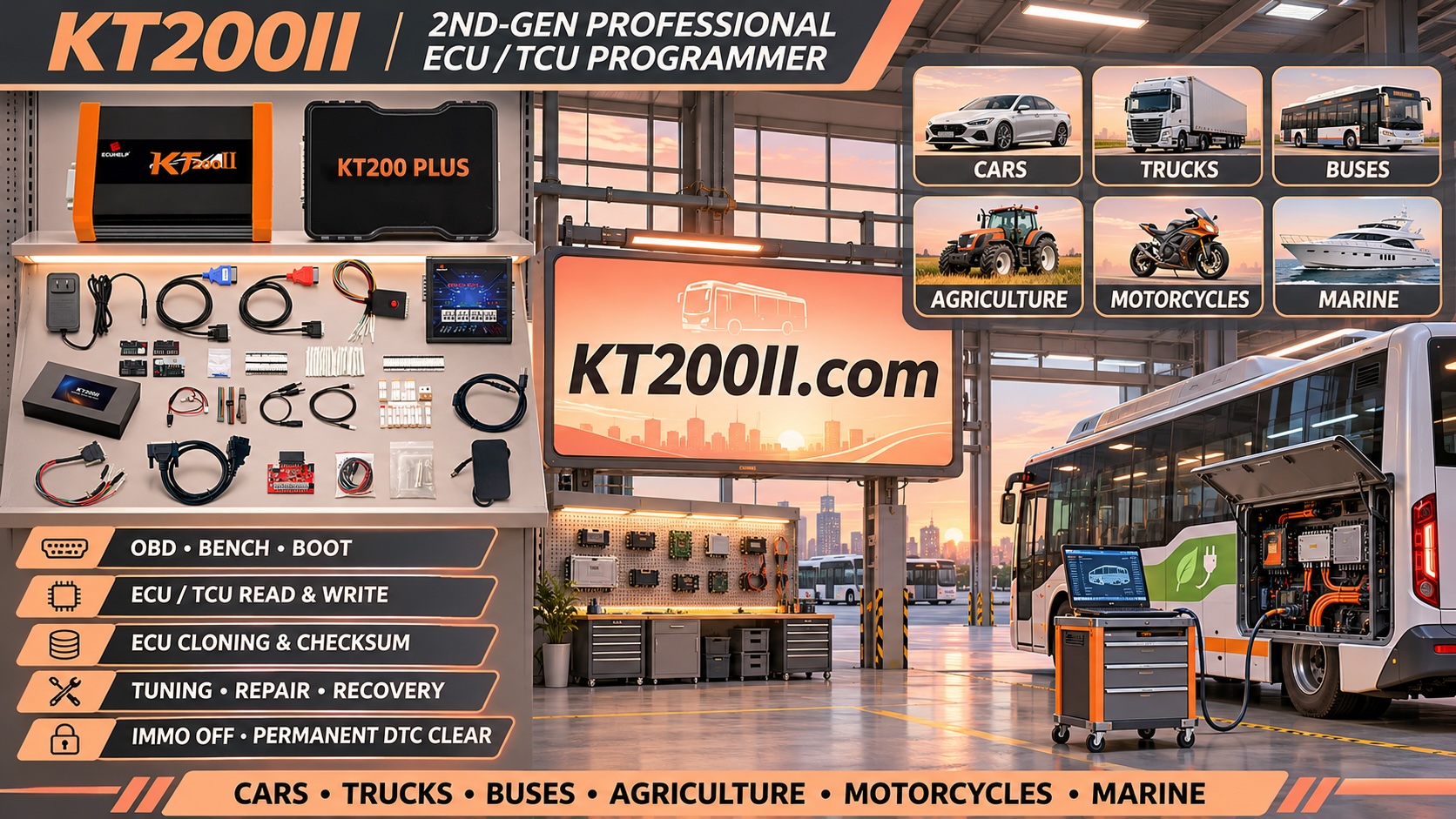
For more information about professional automotive programming equipment and electronic control module solutions, visit KT-Prog.
13. Best Practices for Gasoline ECU Programming
A structured programming workflow helps reduce errors and improve repair reliability.
- Identify the exact vehicle and ECU hardware number.
- Record software identification and processor information.
- Verify the supported programming method.
- Use the correct connection diagram.
- Prepare a suitable regulated power supply.
- Read and save supported original memory data.
- Verify backup files before modification.
- Check software compatibility before writing.
- Follow the manufacturer's programming procedures.
- Perform diagnostic and functional checks after programming.
14. Conclusion
Gasoline ECU programming is an important part of modern automotive electronics repair and engine management. Understanding Bosch MED17, MG1 and other gasoline ECU architectures helps technicians identify control modules and select compatible programming procedures.
Fuel injection, ignition timing, lambda control, turbocharger management and torque protection all depend on coordinated ECU software strategies.
With accurate ECU identification, verified original data and suitable programming equipment, professional workshops can perform supported gasoline ECU reading, writing, cloning and recovery operations more efficiently.
For more information about automotive ECU programming technology and professional programming equipment, visit KT-Prog.